
ENGLISH
TERM 1
A detailed Grade 5 English digital textbook with full explanations, definitions, rules, worked examples, interactive guided practice and topic-specific mastery quizzes.
Punctuation

Punctuation
📚 Complete Guide to Punctuation
Punctuation is the system of marks used in writing to organise sentences and make meaning clear. Punctuation tells a reader where a sentence begins and ends, where to pause, when somebody is asking a question and when words are being quoted directly.
A punctuation mark can change meaning. For example, “Let’s eat, Granny!” means that Granny is being invited to eat. “Let’s eat Granny!” has a completely different meaning because the comma is missing.
| Mark | Meaning and correct use | Example |
|---|---|---|
| Full stop (.) | A full stop is placed at the end of a complete statement or command. It tells the reader that the sentence has finished. | The learners completed their project. |
| Question mark (?) | A question mark is placed at the end of a direct question. It shows that the writer is asking for information. | Where did you leave your school bag? |
| Exclamation mark (!) | An exclamation mark ends a sentence or expression showing strong feeling, surprise, excitement, warning or a forceful command. It should not be overused. | Watch out! / What a fantastic goal! |
| Comma (,) | A comma creates a short separation inside a sentence. It can separate items in a list, separate introductory words or phrases and help prevent confusion. | We packed bread, fruit, water and juice. |
| Apostrophe (’) | An apostrophe has two important jobs: it can show possession and it can show that letters have been left out in a contraction. | Lerato’s book / don’t = do not |
| Quotation marks (“ ”) | Quotation marks show the exact words spoken by a person or quoted from a source. In direct speech, punctuation must work together with the quotation marks. | “Please close the door,” said Mum. |
| Colon (:) | A colon introduces information that explains or expands what comes before it. At Grade 5 level it is often used before a list after a complete introductory statement. | Bring these items: a pencil, ruler and eraser. |
| Semicolon (;) | A semicolon can join two closely related complete sentences without using a coordinating conjunction. It creates a stronger break than a comma but a weaker break than a full stop. | The rain stopped; the players returned to the field. |
| Hyphen (-) | A hyphen joins words or parts of words that work together. It is commonly seen in some compound words and number expressions. | twenty-one / well-known story |
| Dash (—) | A dash creates a strong break in a sentence and can add extra information, emphasis or an interruption. | I opened the box — and froze. |
| Parentheses / brackets ( ) | Parentheses place extra information inside a sentence. The sentence should still make sense if the information inside the brackets is removed. | Māui (a famous culture hero) appears in many traditions. |
| Ellipsis (…) | An ellipsis is a set of three dots. It can show that words have been omitted from a quotation or that a thought trails off. In creative writing it can create suspense when used carefully. | I thought I heard something behind me… |
| Capital letters | Capital letters are not punctuation marks themselves but they work closely with punctuation. They begin sentences and are used for proper nouns such as people, places, days and months. | Naledi visited Durban on Monday. |
🔎 Important Punctuation Rules in Detail
Full stops and sentence boundaries: A full stop belongs after a complete thought. Do not place a full stop after a group of words that cannot stand alone. “Because the bell rang.” is incomplete by itself while “We went inside because the bell rang.” is complete.
Commas in lists: Use commas to separate three or more items. In Class-Mate examples we use the style “apples, pears, oranges and bananas”.
Commas with names being addressed: Use commas around a person’s name when speaking directly to that person: “Sipho, please come here.” This can prevent a serious change of meaning.
Apostrophes for contractions: The apostrophe marks missing letters: can’t = cannot, I’m = I am, we’re = we are and didn’t = did not.
Apostrophes for possession: For one owner, add ’s: the girl’s bag. For a regular plural already ending in s, place the apostrophe after the s: the girls’ bags.
Direct speech: Start the spoken words with a capital letter. Put the exact spoken words inside quotation marks. When a reporting clause follows, a comma normally separates the spoken words from the reporting clause: “I am ready,” said Leo.
Question and exclamation marks in direct speech: If the spoken words are a question or exclamation, the ? or ! stays inside the closing quotation mark: “Are you ready?” asked Leo.
Avoid over-punctuation: More punctuation does not make writing stronger. Choose the mark that expresses the grammatical relationship and intended meaning.
✏️ Worked Examples
| Example | Explanation / Correct Use |
|---|---|
| Statement | The learners finished their work. |
| Question | Where did you put the ruler? |
| List | We packed bread, fruit, water and juice. |
| Direct speech | “Please sit down,” said Mr Naidoo. |
| Possession | Amina’s pencil . Contraction: don’t = do not . |
🧩 Guided Practice
1. Add the correct end mark: What time does school start__
2. Correct: my friend said i cant come today
3. Add commas: We bought apples pears oranges and bananas.
🎯 Independent Challenge
Edit a six-sentence paragraph containing at least ten punctuation and capital-letter errors. Explain five corrections.
Power Quiz
Apply what you learned. Score 80% or more to master this lesson.
1. Which sentence is punctuated correctly?
2. Which sentence uses the apostrophe for possession correctly?
3. Choose the correctly punctuated direct speech.
4. Which sentence uses commas correctly in a list?
5. Why is a question mark needed in 'Are you coming with us__'?
Common and Proper Nouns

Common and Proper Nouns
A noun names a person, place, animal, thing or idea. A common noun gives a general name. A proper noun gives the official or specific name of a person, place, day, month, organisation or special title.
Proper nouns begin with capital letters because they identify one particular name.
📘 Rules & How It Works
| Rule / Concept | Detailed Explanation |
|---|---|
| Common | city, teacher, river, country, month. |
| Proper | Durban, Mrs Dlamini, Gariep River, South Africa, January. |
| A common noun can appear inside a proper name | Table Mountain , Kruger National Park . |
✏️ Worked Examples
| Example | Explanation / Correct Use |
|---|---|
| city | Johannesburg |
| river | Vaal River |
| girl | Naledi |
| school | Sunrise Primary School |
⚠️ Common Mistakes
| Incorrect / Problem | Correct Form / Explanation |
|---|---|
| ❌ I live in durban. | ✅ I live in Durban. |
| ❌ We visit the kruger national park. | ✅ We visit Kruger National Park. |
| Common mistake | Do not capitalise ordinary common nouns just because they seem important: My Teacher gave us Homework is incorrect. |
🧩 Guided Practice
1. Underline common nouns: The girl carried a book to school.
2. Correct capitals: we visited cape town in july.
3. Give a proper noun for 'country'.
🎯 Independent Challenge
Make a two-column chart of 12 common nouns and matching proper nouns from South Africa.
Power Quiz
Apply what you learned. Score 80% or more to master this lesson.
1. Which is a proper noun?
2. Which is a common noun?
3. Which sentence has correct capitalisation?
4. Why is 'Nelson Mandela' a proper noun?
5. Which pair is common noun → proper noun?
Prefixes

Prefixes
A prefix is a meaningful group of letters added to the beginning of a base word. It changes meaning without necessarily changing the main idea of the base word.
Knowing prefixes helps readers decode unfamiliar words. If you know re- means 'again', you can work out that rebuild means build again.
📘 Rules & How It Works
| Rule / Concept | Detailed Explanation |
|---|---|
| un- often means not/opposite | unhappy, unfair. |
| re- often means again/back | reread, return. |
| dis- can mean not/opposite/apart | disagree, disconnect. |
| pre- means before | preview, preheat. |
| mis- means wrongly/badly | misspell, misunderstand. |
✏️ Worked Examples
| Example | Explanation / Correct Use |
|---|---|
| happy | unhappy = not happy |
| write | rewrite = write again |
| agree | disagree = not agree |
| view | preview = view before |
| spell | misspell = spell incorrectly |
⚠️ Common Mistakes
| Incorrect / Problem | Correct Form / Explanation |
|---|---|
| Common mistake | Not every word beginning with the same letters contains a prefix. uncle does not mean 'not cle'. |
| Common mistake | ❌ rewent. After re- , use a suitable base word: rewrite , replay , rebuild . |
🧩 Guided Practice
1. Break 'unhelpful' into parts.
2. What does 'preview' mean?
3. Create a word meaning 'spell wrongly'.
🎯 Independent Challenge
Create a prefix wheel using un-, re-, dis-, pre- and mis-. Build two correct words with each.
Power Quiz
Apply what you learned. Score 80% or more to master this lesson.
1. What does the prefix re- usually mean in 'rewrite'?
2. Which word means 'not fair'?
3. What is the base word in 'disagree'?
4. Which word means 'look at something before the main event'?
5. Which word uses mis- correctly?
Suffixes
Suffixes
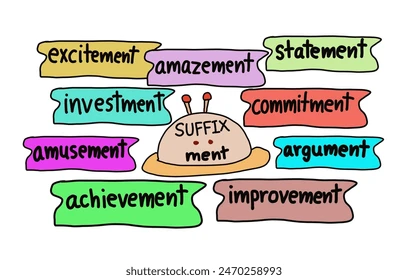
A suffix is a group of letters added to the end of a base word. Suffixes can change the meaning of a word or change its grammatical class.
For example, kind is an adjective. Add -ness and it becomes the noun kindness.
📘 Rules & How It Works
| Rule / Concept | Detailed Explanation |
|---|---|
| -ful = full of | helpful, careful. |
| -less = without | careless, hopeless. |
| -ness often makes a noun | happy → happiness. |
| -er can name a person who does an action | teach → teacher. |
| -ly often forms an adverb | quick → quickly. |
✏️ Worked Examples
| Example | Explanation / Correct Use |
|---|---|
| Example | help + ful = helpful |
| Example | hope + less = hopeless |
| Example | happy + ness = happiness |
| Example | teach + er = teacher |
| Example | careful + ly = carefully |
⚠️ Common Mistakes
| Incorrect / Problem | Correct Form / Explanation |
|---|---|
| Spelling may change: happy | happiness; easy → easily. |
| Common mistake | Not every -ly word is an adverb: friendly is usually an adjective. |
| Common mistake | A word may have both prefix and suffix: unhelpful . |
🧩 Guided Practice
1. Change 'kind' into a noun.
2. Make a word meaning 'without hope'.
3. Change 'quick' into an adverb.
🎯 Independent Challenge
Use five base words to build at least eight new words with -ful, -less, -ness, -er or -ly.
Power Quiz
Apply what you learned. Score 80% or more to master this lesson.
1. Where is a suffix added?
2. What does 'hopeless' mean?
3. Which word is a noun formed with -ness?
4. Which suffix helps form the adverb 'carefully'?
5. Which word contains both a prefix and suffix?
Simple present tense

Simple present tense
The simple present tense describes habits, repeated actions, general truths and states. It does not mainly describe an action happening at this exact second.
With I, you, we, they, use the base verb. With he, she, it, the verb usually takes -s or -es.
📘 Rules & How It Works
| Rule / Concept | Detailed Explanation |
|---|---|
| Rule | I/you/we/they play . He/she/it plays . |
| Verbs ending in -s, -sh, -ch, -x or -o often take -es | watches, fixes, goes. |
| Consonant + y may change to -ies | study → studies. |
| Be is irregular | I am, she is, they are. |
| Rule | Have becomes has with he/she/it. |
✏️ Worked Examples
| Example | Explanation / Correct Use |
|---|---|
| Routine | I walk to school every day. |
| Truth | Water freezes at 0°C under standard conditions. |
| State | She likes mystery stories. |
⚠️ Common Mistakes
| Incorrect / Problem | Correct Form / Explanation |
|---|---|
| ❌ He walk to school. | ✅ He walks to school. |
| ❌ They goes home. | ✅ They go home. |
| Common mistake | Do not use simple past with 'every day' unless describing an old routine. |
🧩 Guided Practice
1. Choose: She (read/reads) every night.
2. Correct: The dogs barks loudly.
3. Write one general truth in simple present.
🎯 Independent Challenge
Write six simple-present sentences: three routines, two general truths and one state.
Power Quiz
Apply what you learned. Score 80% or more to master this lesson.
1. Which sentence is in the simple present?
2. Choose the correct form: 'He ___ his homework after school.'
3. Which sentence has correct agreement?
4. Which word often signals a routine?
5. Why is 'The Earth moves around the Sun' simple present?
Simple past tense

Simple past tense
The simple past describes an action or state that happened before now and is finished.
Regular verbs often form the past with -ed. Irregular verbs have special forms that must be learned.
📘 Rules & How It Works
| Rule / Concept | Detailed Explanation |
|---|---|
| play | played; clean → cleaned. |
| carry | carried; study → studied. |
| stop | stopped; plan → planned. |
| go | went; see → saw; eat → ate; write → wrote; take → took. |
✏️ Worked Examples
| Example | Explanation / Correct Use |
|---|---|
| Example | We visited the museum yesterday. |
| Example | She wrote a story last night. |
| Example | They went home after the match. |
⚠️ Common Mistakes
| Incorrect / Problem | Correct Form / Explanation |
|---|---|
| ❌ goed | ✅ went |
| ❌ eated | ✅ ate |
| ❌ writed | ✅ wrote |
| Do not mix time: ❌ Yesterday I walk to school. | ✅ Yesterday I walked to school. |
🧩 Guided Practice
1. Past of 'carry'.
2. Past of 'see'.
3. Correct: Last week we go to Durban.
🎯 Independent Challenge
Write an eight-sentence diary entry about yesterday using four regular and four irregular past verbs.
Power Quiz
Apply what you learned. Score 80% or more to master this lesson.
1. What is the past tense of 'go'?
2. Which sentence is simple past?
3. Which is a regular past-tense form?
4. What is the correct past form of 'write'?
5. Which time expression most strongly signals the simple past?
Simple future tense
Simple future tense
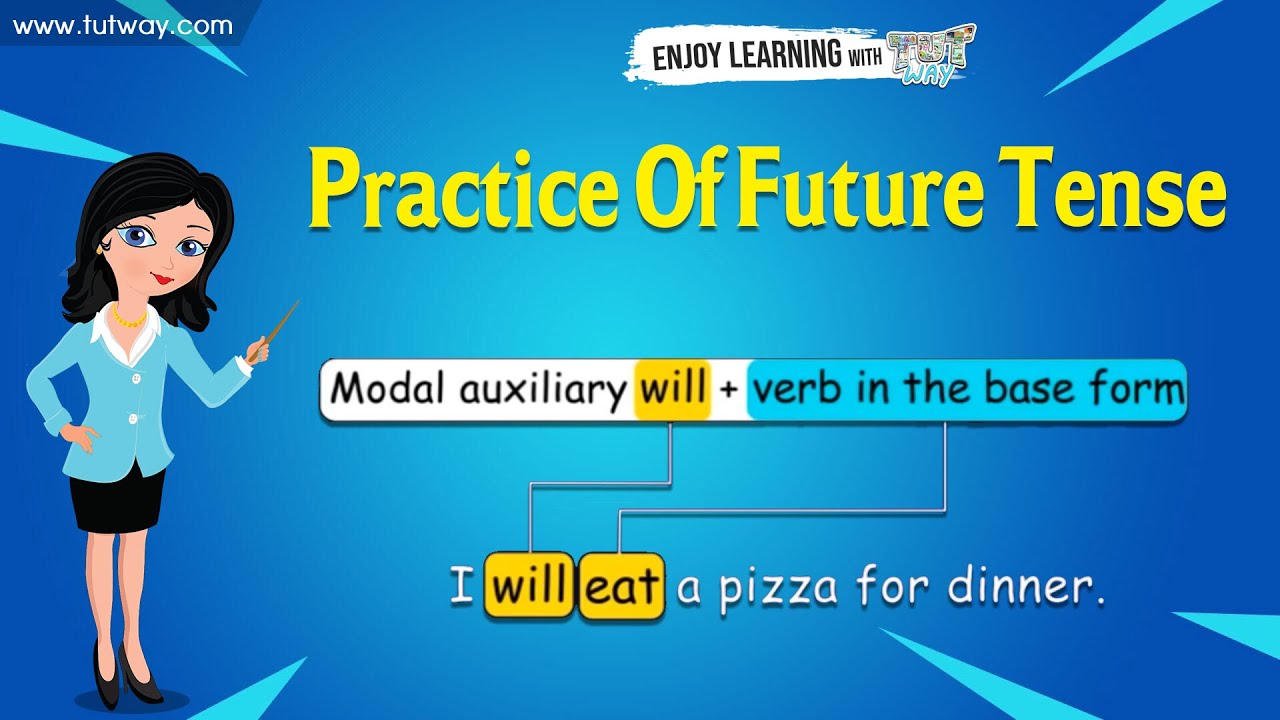
The simple future refers to actions or events after the present. A common Grade 5 structure is will + base verb.
We can also use going to for plans and strong expectations.
📘 Rules & How It Works
| Rule / Concept | Detailed Explanation |
|---|---|
| will + base verb | will go, will read, will play. |
| Rule | Do not change the main verb after will. |
| Future markers | tomorrow, next week, later, soon, in the future. |
✏️ Worked Examples
| Example | Explanation / Correct Use |
|---|---|
| Example | I will finish my project tonight. |
| Example | They will travel next month. |
| Example | We are going to visit Granny on Saturday. |
⚠️ Common Mistakes
| Incorrect / Problem | Correct Form / Explanation |
|---|---|
| ❌ will went | ✅ will go |
| ❌ will plays | ✅ will play |
| ❌ She will to read. | ✅ She will read. |
🧩 Guided Practice
1. Future of 'He walks home'.
2. Correct: We will went tomorrow.
3. Write one future prediction.
🎯 Independent Challenge
Make a tense table with five verbs in present, past and future forms.
Power Quiz
Apply what you learned. Score 80% or more to master this lesson.
1. Which sentence is simple future?
2. What form follows 'will'?
3. Which is correct?
4. Which phrase suggests future time?
5. Change to future: 'They play soccer.'
Synonyms

Synonyms
Synonyms are words with the same or similar meanings. They are useful for vocabulary growth and for avoiding unnecessary repetition.
However, synonyms are not always identical. Words can differ in strength, formality or feeling.
📘 Rules & How It Works
| Rule / Concept | Detailed Explanation |
|---|---|
| Rule | happy ↔ joyful; begin ↔ start; silent ↔ quiet. |
| Rule | big, large, enormous and gigantic are related but not equally strong. |
| Rule | Context decides which synonym fits. |
✏️ Worked Examples
| Example | Explanation / Correct Use |
|---|---|
| Weak | The nice dog had a nice owner. Better: The friendly dog had a kind owner. |
| Example | stroll , walk and march all involve movement but suggest different styles. |
⚠️ Common Mistakes
| Incorrect / Problem | Correct Form / Explanation |
|---|---|
| Common mistake | Do not replace a word just because a thesaurus lists it. Reread the whole sentence. |
| Common mistake | Bright can mean full of light or intelligent. The correct synonym depends on the intended meaning. |
🧩 Guided Practice
1. Synonym for 'begin'.
2. Choose a stronger synonym for 'big'.
3. Replace repeated 'nice' with a precise word.
🎯 Independent Challenge
Rewrite a five-sentence paragraph containing the word 'nice' five times using five more precise choices.
Power Quiz
Apply what you learned. Score 80% or more to master this lesson.
1. Which pair are synonyms?
2. Which word is the strongest synonym for 'big'?
3. Why must you check context before using a synonym?
4. Which best replaces 'silent' in 'the silent room'?
5. What resource is designed to help find synonyms?
Comprehension: The Tree House

Comprehension: The Tree House
This is a mystery/fantasy-style narrative. Before answering questions, separate what the writer states from what the writer only suggests.
The writer creates suspense with the quiet night, barking dogs, secret movement, mysterious green light and unanswered question about who is inside the tree house.
📘 Rules & How It Works
| Rule / Concept | Detailed Explanation |
|---|---|
| Literal question | answer directly from the passage. |
| Inference | combine a clue with logical reasoning. |
| Evidence | quote or refer to the detail that supports your idea. |
| Story element | identify setting, characters, events, climax and theme. |
✏️ Worked Examples
| Example | Explanation / Correct Use |
|---|---|
| Literal | The tree house was built for the twins’ father when he was a boy. |
| Inference | The girls have probably visited before because Ashlea knows the back door will be unlocked. |
| Suspense clue | the brilliant emerald-green light appears and disappears suddenly. |
⚠️ Common Mistakes
| Incorrect / Problem | Correct Form / Explanation |
|---|---|
| Common mistake | Do not invent evidence that is not in the passage. |
| Common mistake | For open-ended questions, creativity is allowed only if the answer remains consistent with the clues. |
| Common mistake | A theme is a broad idea such as secrecy, belonging or family connection, not simply 'the tree house'. |
📖 YOUR SUPPLIED COMPREHENSION — THE TREE HOUSE
1 The silence of the still, cloudless night is interrupted by the
frantic barking of two Maltese terriers. The twins, Ashlea and
Krystal, look up at the window. Smiles appear on their identical
faces. “Time to go!” thinks Ashlea. The girls slide down their beds
and sneak into the dark corridor. Ashlea reaches for Krystal’s
hand and they walk, barefoot, past their parents’ bedroom. The twins overhear a
discussion about the noisy dogs. Their father yells in a loud, stern voice for the dogs to be
quiet. His wife has decided that there must be large rats in the roof, setting the dogs off.
Ashlea opens the back door, knowing it won’t be locked. The girls walk by the dogs that
are still barking and snapping their jaws up towards the star-filled sky. They arrive at the
base of the largest tree in the garden. They look up - their exotic, almond-shaped eyes
twinkle with anticipation.
2 Ashlea reaches for the first wooden rung of the makeshift ladder. Krystal follows her,
climbing up towards their tree house. Ashlea pauses.
“I am being careful!” Krystal whispers with a furrowed brow.
The tree house sits in branches of the oldest tree in the garden. It was built for their father
when he was a little boy, with planks of wood nailed together for walls and a ceiling, and an
old piece of plaster board acting as a miniature door. The girls love their tree house
because it is the perfect size for them, but its low ceiling means that adults only ever climb
up the ladder and peer in – they never enter.
The girls reach the top.
Ashlea calls, “We’re here”.
“Can we come with you?” Krystal asks excitedly. The girls climb inside.
If the girls’ mother had opened the bedroom window at that very moment, and looked at
the tree house, she would have seen shards of brilliant emerald-green light escaping out of
the gaps in the wood and from under the door. As quickly as the green light appears, it is
gone. The tree house becomes a nest of shadows once more. The dogs’ barking stops,
fading into the cloudless, still night, once again.
GM 2018
19
3 The next morning, the girls are pouring cereal into their bowls, discussing whether they
had any homework, when their mother enters the kitchen.
“Goodness! You girls are so quiet! People will think you don’t like each other.” Their mother
takes the phone off charge. “I must call someone about the rats in our roof.”
Krystal, with a mouth full of cereal, thinks, “They won’t find any rats here”.
“I know,” responds Ashlea, giggling.
“What’s so funny?” their mother inquires.
“Nothing Mother,” Ashlea places her bowl in the sink.
“We are going to school now.”
4 The twins collect their backpacks and kiss their
mother goodbye. They begin the short walk through
their garden to the back fence of the school. They look
over at the tree house to see their father standing at its
base, deep in thought. Krystal shudders and begins to worry that he might try to stop them
from visiting the tree house at night. She looks over at her older sister…waiting. Creases
in Ashlea’s forehead appear. She nods and thinks, “Don’t worry, Krystal. He’s just wishing
that he could come to the tree house with us at night too. He misses it”.
Krystal grins and starts happily skipping towards the school gate.
📝 Questions from your supplied source
1. Answer true or false.a) The dogs stop barking after the twins’ father yells at them to be quiet.
b) An adult could easily fit through the door of the tree house.
c) The twins’ mother worries about their constant arguing.
d) The girls are excited about their night-time visits to their tree house.
e) Krystal is older than Ashlea.
2. Do you think the twins’ father knows what happens after the light appears in the tree
house? Why?
3. Why do you think the dogs eventually stop barking?
4. Have the girls visited the tree house at night before? Why do you think so?
5. Who do you think leaves the back door open for the girls at night?
6. What is so special about the twins in the story?
7. The girls asked whoever was in the tree house if they could go with them. Where do
you think they go and with whom?
8. Write the following headings and complete the information according to the story.
Setting -
Characters -
Theme -
Climax -
Events -
Your opinion of the story (like/dislike) -
9. Who do you think the girls were talking to inside the tree house? Be as creative as you
like.
🧩 Guided Practice
1. What is the setting at the start?
2. Give one clue that the visit has happened before.
3. Identify the likely climax.
🎯 Independent Challenge
Complete the supplied story-element task and then write a 60-word explanation of the mystery using at least three clues.
Power Quiz
Apply what you learned. Score 80% or more to master this lesson.
1. Why do Ashlea and Krystal leave their beds?
2. Why do adults normally not enter the tree house?
3. Which detail best suggests the girls have visited at night before?
4. What is the strongest candidate for the climax?
5. Which answer is an inference rather than a stated fact?
Write Your Own Story

Write Your Own Story
A story is not simply a list of events. A strong narrative gives a character a goal or problem and then develops events that move towards a climax and resolution.
Before writing, decide who the main character is, where the story happens and what changes or goes wrong.
📘 Rules & How It Works
| Rule / Concept | Detailed Explanation |
|---|---|
| Beginning | introduce character and setting. |
| Middle | develop the problem through rising action. |
| Climax | the most important or tense event. |
| Resolution | show what happens after the climax. |
| Rule | Keep point of view and tense consistent. |
✏️ Worked Examples
| Example | Explanation / Correct Use |
|---|---|
| Opening hook | The locked classroom door slowly opened by itself. |
| Dialogue | “Did you hear that?” whispered Ayanda. |
| Description | replace 'went quickly' with rushed or sprinted when appropriate. |
⚠️ Common Mistakes
| Incorrect / Problem | Correct Form / Explanation |
|---|---|
| Common mistake | Avoid a beginning that spends half the story on waking up and eating breakfast unless it matters. |
| Common mistake | Avoid solving the problem suddenly with no preparation. |
| Common mistake | Do not change from I to she/he without a reason. |
| Common mistake | Do not write dialogue without new paragraphs for new speakers. |
🧩 Guided Practice
1. Create a character with one strength and one weakness.
2. Write the story problem in one sentence.
3. Write one possible climax.
🎯 Independent Challenge
Plan and write a 250–350 word story titled 'The Door That Should Never Open'.
Power Quiz
Apply what you learned. Score 80% or more to master this lesson.
1. What should the middle of a story mainly do?
2. What is the climax?
3. Which opening creates the strongest hook?
4. Why should a story keep a consistent point of view?
5. Which ending is weakest?
The Writing Process

The Writing Process
Good writing is usually made in stages. The first version is not expected to be perfect.
Revision improves the ideas and organisation. Editing improves correctness.
📘 Rules & How It Works
| Rule / Concept | Detailed Explanation |
|---|---|
| 1. Plan | purpose, audience, ideas and structure. |
| 2. Draft | write the first version. |
| 3. Revise | add, remove, reorder or improve ideas. |
| 4. Edit | check spelling, grammar, punctuation and sentences. |
| 5. Publish/present | prepare the final version. |
✏️ Worked Examples
| Example | Explanation / Correct Use |
|---|---|
| Revision | change The dog was nice to The nervous puppy slowly trusted the child if the detail matters. |
| Editing | correct the puppy dont bark to The puppy doesn’t bark. |
⚠️ Common Mistakes
| Incorrect / Problem | Correct Form / Explanation |
|---|---|
| Common mistake | Do not spend so long decorating a final copy that you skip revision. |
| Common mistake | Spell-check does not replace careful editing because correctly spelled homophones can still be wrong. |
🧩 Guided Practice
1. Which stage comes before drafting?
2. Is changing paragraph order revision or editing?
3. Is correcting a missing apostrophe revision or editing?
🎯 Independent Challenge
Take one rough paragraph and produce a revised version and then a separately edited final version.
Power Quiz
Apply what you learned. Score 80% or more to master this lesson.
1. What should happen before drafting?
2. Which is a revision change?
3. Which is an editing change?
4. Why is the first draft allowed to be imperfect?
5. Which order is correct?
Verbs

Verbs
A verb is the engine of a sentence. It tells what someone or something does or is.
Some verbs show actions. Others show states. Helping verbs combine with main verbs.
📘 Rules & How It Works
| Rule / Concept | Detailed Explanation |
|---|---|
| Action | run, build, whisper, think. |
| State/linking | be, seem, know, belong. |
| Helping + main | is reading, has finished, will leave. |
| Verbs change with tense | walk, walked, will walk. |
✏️ Worked Examples
| Example | Explanation / Correct Use |
|---|---|
| Example | The dog barked. action verb = barked. |
| Example | The soup smells delicious. linking/state verb = smells. |
| Example | They are studying. verb phrase = are studying. |
⚠️ Common Mistakes
| Incorrect / Problem | Correct Form / Explanation |
|---|---|
| Common mistake | Do not assume every -ing word is the whole verb. In is running , both words form the verb phrase. |
| Common mistake | A sentence fragment may be missing a finite verb. |
🧩 Guided Practice
1. Find the verb: The birds sang loudly.
2. Find the verb phrase: She has finished her book.
3. Change 'walk' to simple past.
🎯 Independent Challenge
Find and classify the verbs in 12 sentences as action, state/linking or helping + main.
Power Quiz
Apply what you learned. Score 80% or more to master this lesson.
1. What is the verb in 'The dog barked loudly'?
2. Which sentence contains a helping verb?
3. Which is a state/linking verb in 'The soup smells delicious'?
4. What is the verb phrase in 'She has finished her work'?
5. Which set shows tense change?
Subject-verb agreement (Concord)
Subject-verb agreement (Concord)
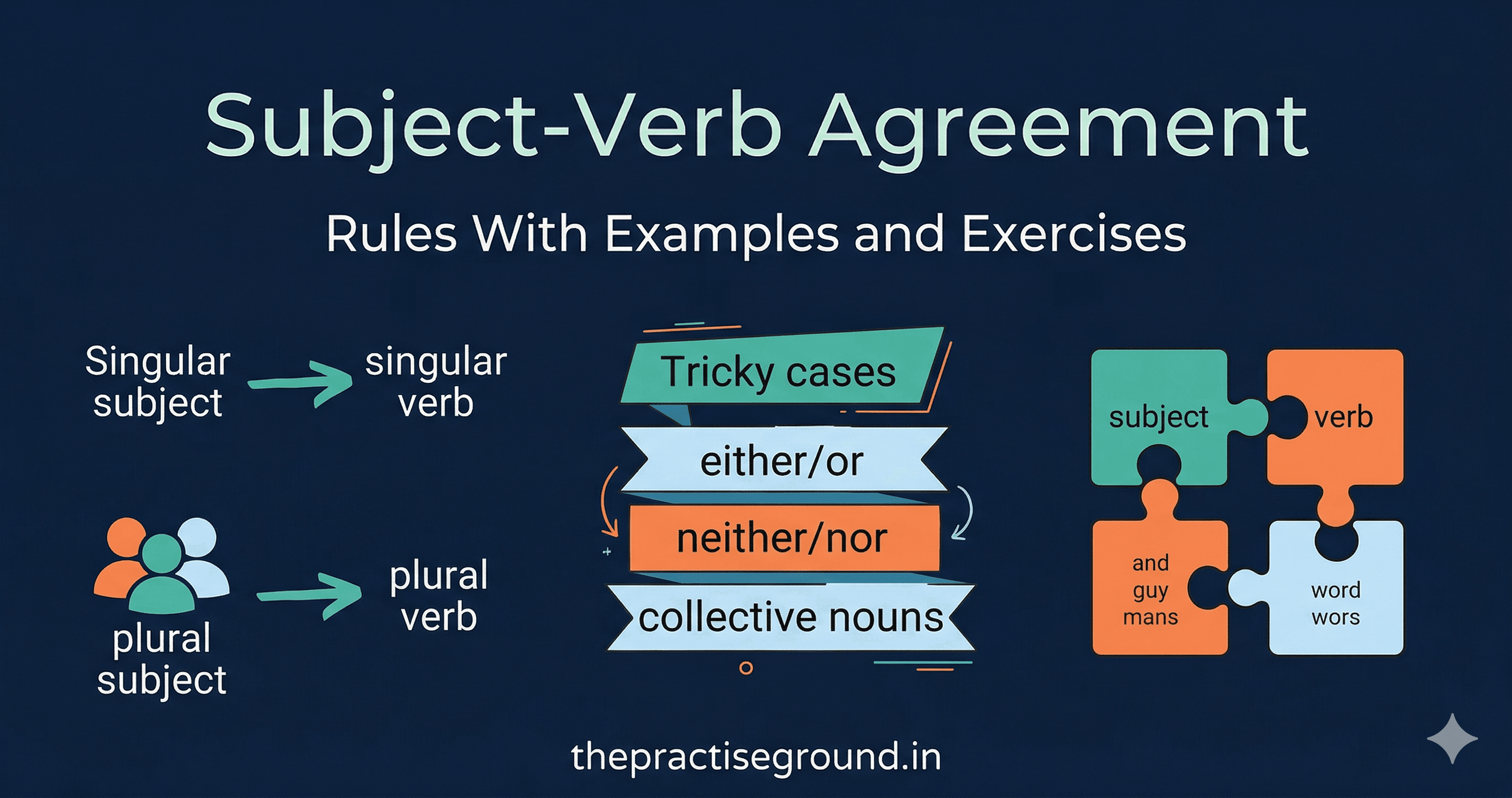
Concord means grammatical agreement. In Grade 5, the most important pattern is matching the subject and verb.
A singular third-person subject normally takes a present-tense verb with -s/-es. A plural subject normally takes the base form.
📘 Rules & How It Works
| Rule / Concept | Detailed Explanation |
|---|---|
| Rule | The boy runs . The boys run . |
| Rule | She has . They have . |
| Rule | He is . They are . |
| A subject joined by and is normally plural | Musa and Amina play . |
| Ignore an intervening phrase | The box of pencils is heavy. |
✏️ Worked Examples
| Example | Explanation / Correct Use |
|---|---|
| Example | The group of learners is waiting. Subject = group. |
| Example | My friends are ready. Subject = friends. |
| Example | Each learner has a book. Subject = each learner. |
⚠️ Common Mistakes
| Incorrect / Problem | Correct Form / Explanation |
|---|---|
| ❌ She walk. | ✅ She walks. |
| ❌ The dogs barks. | ✅ The dogs bark. |
| ❌ The basket of apples are heavy. | ✅ The basket of apples is heavy. |
🧩 Guided Practice
1. Choose: The puppy (sleep/sleeps).
2. Choose: The puppies (sleep/sleeps).
3. Correct: My brother have a bicycle.
🎯 Independent Challenge
Correct ten concord errors and underline the subject responsible for each correction.
Power Quiz
Apply what you learned. Score 80% or more to master this lesson.
1. Choose the correct sentence.
2. Complete: 'The dogs ___ loudly every night.'
3. Complete: 'My brother ___ a bicycle.'
4. Why is 'The box of pencils is heavy' correct?
5. Which sentence shows correct subject–verb agreement?
Information Text: The Dangers of Plastic Shopping Bags

Information Text: The Dangers of Plastic Shopping Bags
An information text explains a real topic using facts, examples, causes, effects and sometimes suggested responses.
This passage moves from the size of the plastic-bag problem to specific environmental effects and then to actions taken in Ireland and Japan.
📘 Rules & How It Works
| Rule / Concept | Detailed Explanation |
|---|---|
| Rule | Read the title and predict the issue. |
| Rule | Underline statistics and factual examples. |
| Trace cause | effect relationships. |
| Rule | Separate problems from solutions. |
| Rule | Summarise each paragraph in one sentence. |
✏️ Worked Examples
| Example | Explanation / Correct Use |
|---|---|
| Cause/effect | discarded bags clog drainage systems → flooding risk increases. |
| Animal impact | whales and birds may ingest plastic. |
| Solution | Ireland used a tax; some Japanese stores reward reusable bags. |
⚠️ Common Mistakes
| Incorrect / Problem | Correct Form / Explanation |
|---|---|
| Common mistake | Do not copy a whole paragraph as a summary. |
| Common mistake | A statistic must be quoted accurately: the text says only about 1 to 3 per cent are recycled. |
| Common mistake | Do not confuse an example from one country with a claim about every country. |
📘 YOUR SUPPLIED TEXT — DANGERS OF SHOPPING BAGS
Dangers of Shopping Bags
Shopping bags, although convenient, have created major environmental
issues around the world. Scientists estimate that up to one trillion plastic
shopping bags are used each year around the globe. Hundreds of millions of
these bags end up being thrown away annually. Studies have shown that
only about 1 to 3 per cent of plastic shopping bags are recycled. This has
created a load of plastic bags in landfills, streets, and waters throughout the
world. The environmental consequence of this overload could be
catastrophic.
In the late 1980s and 1990s, plastic bags were responsible for causing floods in most of
Bangladesh. Experts found that many people were throwing out their plastic bags as
litter. The drainage systems throughout the country became clogged with them and this
caused the floods.
Animals have also suffered. In Western Europe, marine biologists have found that many
whales have died from ingesting plastic bags. The whales mistake the bags for prey and
swallow them. This damages their insides and eventually kills them. Flamingos and
pelicans who scavenge along shores have also died after eating a plastic bag.
Last but not least, plastic bags may be altering the ecosystem of the world’s
oceans. Marine biologists have learned that ocean species will often “catch a ride” on
plastic debris in the water. This lets them travel farther and more quickly than they could
under their own power. After arriving at their destination, these traveling species will then
eat the native species. This is a grave threat to marine biodiversity.
To combat these problems, many stores and governments have sought alternatives to
plastic shopping bags. In Ireland, for example, politicians passed a new law that levied a
tax of 15 cents for consumers who use a plastic shopping bag. In places like Japan, some
stores offer a small discount to shoppers who bring their own reusable bag for carrying
home their purchases.
🧩 Guided Practice
1. What percentage does the text say is recycled?
2. How did bags contribute to flooding in Bangladesh?
3. Name two responses to plastic-bag problems.
🎯 Independent Challenge
Create a cause-effect-solution chart using at least six facts from the supplied text.
Power Quiz
Apply what you learned. Score 80% or more to master this lesson.
1. What is the main purpose of the passage?
2. What percentage of plastic shopping bags does the text say are recycled?
3. How did discarded bags contribute to floods in Bangladesh?
4. Why do some whales die after swallowing plastic bags?
5. Which response is mentioned in the passage?
Prepositions

Prepositions
A preposition shows a relationship between a noun or pronoun and another part of the sentence.
Prepositions commonly tell where, when or in what direction.
📘 Rules & How It Works
| Rule / Concept | Detailed Explanation |
|---|---|
| Place | under the table, beside the gate, between the chairs. |
| Time | at 7:00, on Monday, in June. |
| Direction | through the tunnel, across the road, towards school. |
| Rule | A prepositional phrase begins with the preposition and includes its object. |
✏️ Worked Examples
| Example | Explanation / Correct Use |
|---|---|
| Example | The cat slept under the chair. |
| Example | We meet on Tuesday. |
| Example | She ran across the field. |
⚠️ Common Mistakes
| Incorrect / Problem | Correct Form / Explanation |
|---|---|
| ❌ in Monday | ✅ on Monday |
| ❌ at July | ✅ in July |
| Common mistake | Do not underline only the noun if asked for the phrase: under the old table is the full phrase. |
🧩 Guided Practice
1. Find the preposition: The ball rolled under the car.
2. Choose: We meet (in/on/at) Friday.
3. Identify the phrase: She walked through the gate.
🎯 Independent Challenge
Give a partner written directions around a classroom using at least eight different prepositions.
Power Quiz
Apply what you learned. Score 80% or more to master this lesson.
1. Which word is the preposition in 'The book is under the desk'?
2. Which phrase shows time?
3. Choose the correct phrase.
4. What is the complete prepositional phrase in 'The dog slept beside the door'?
5. Which preposition best completes 'She walked ___ the bridge'?
Articles

Articles
Articles are determiners placed before nouns. English has a, an and the.
A/an introduce one non-specific countable noun. The usually points to a specific or already known noun.
📘 Rules & How It Works
| Rule / Concept | Detailed Explanation |
|---|---|
| Use a before a consonant sound | a dog, a uniform. |
| Use an before a vowel sound | an apple, an hour. |
| Use the for a specific known noun | the book you lent me. |
| Rule | The a/an choice depends on sound, not just the first letter. |
✏️ Worked Examples
| Example | Explanation / Correct Use |
|---|---|
| Example | a university because university begins with a /y/ sound. |
| Example | an hour because the h is silent. |
| Example | I saw a dog . Later, the dog followed me home. |
⚠️ Common Mistakes
| Incorrect / Problem | Correct Form / Explanation |
|---|---|
| ❌ an uniform | ✅ a uniform |
| ❌ a hour | ✅ an hour |
| Common mistake | Do not use a/an with an ordinary plural noun: ❌ a books. |
🧩 Guided Practice
1. Choose: __ orange.
2. Choose: __ useful tool.
3. Explain the difference between 'a book' and 'the book'.
🎯 Independent Challenge
Create ten noun phrases using a, an and the. Include an hour, a uniform and a university.
Power Quiz
Apply what you learned. Score 80% or more to master this lesson.
1. Which phrase correctly uses an indefinite article before a consonant sound?
2. Which phrase correctly uses an article before a vowel sound?
3. Why do we say 'a university'?
4. When do we often use 'the'?
5. Which sentence is correct?
Determiners

Determiners
A determiner comes before a noun and helps identify, point to, show ownership of or limit that noun.
Articles are determiners but Grade 5 learners also need demonstratives, possessives and quantity words.
📘 Rules & How It Works
| Rule / Concept | Detailed Explanation |
|---|---|
| Demonstratives | this, that, these, those. |
| Possessives | my, your, his, her, its, our, their. |
| Quantity | some, many, few, several, each, every. |
| Number words can also limit nouns | three books. |
✏️ Worked Examples
| Example | Explanation / Correct Use |
|---|---|
| Example | those three red balloons |
| Example | my new school bag |
| Example | several difficult questions |
⚠️ Common Mistakes
| Incorrect / Problem | Correct Form / Explanation |
|---|---|
| Common mistake | Do not confuse their before a noun with theirs standing alone. |
| ❌ these three red balloon | ✅ these three red balloons. |
| Common mistake | Determiners usually appear before adjectives: those old books . |
🧩 Guided Practice
1. Find the determiner: Those shoes are muddy.
2. Identify type: my pencil.
3. Choose: ___ learners finished. (Many/Much)
🎯 Independent Challenge
Expand the noun 'books' in six different ways using articles, demonstratives, possession, quantity and numbers.
Power Quiz
Apply what you learned. Score 80% or more to master this lesson.
1. Which word is the determiner in 'those shoes'?
2. Which is a possessive determiner?
3. Which phrase contains a quantity determiner?
4. Which phrase has correct word order?
5. What does a determiner do?
Antonyms
Antonyms
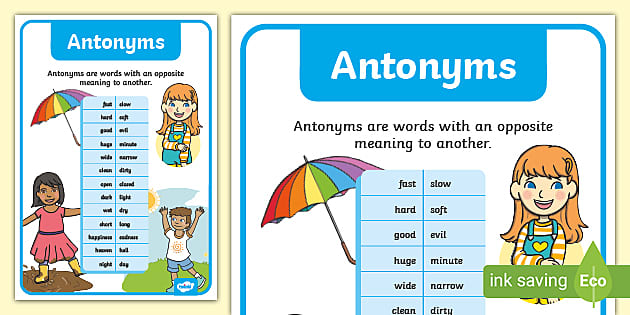
Antonyms are words with opposite or contrasting meanings.
Some are direct opposites. Others sit at opposite ends of a scale.
📘 Rules & How It Works
| Rule / Concept | Detailed Explanation |
|---|---|
| Rule | hot ↔ cold; enter ↔ exit; generous ↔ selfish. |
| Gradable | hot — warm — cool — cold. |
| Prefixes can form opposites | possible → impossible; honest → dishonest. |
✏️ Worked Examples
| Example | Explanation / Correct Use |
|---|---|
| The antonym of light depends on meaning | dark for brightness, heavy for weight. |
| Example | The antonym of ancient is modern. |
⚠️ Common Mistakes
| Incorrect / Problem | Correct Form / Explanation |
|---|---|
| Common mistake | Do not choose an opposite by spelling alone. |
| Common mistake | Not every word has one perfect antonym. Context decides. |
🧩 Guided Practice
1. Antonym of 'generous'.
2. Opposite of 'light' in 'a light bag'.
3. Opposite of 'light' in 'a light room'.
🎯 Independent Challenge
Create eight antonym pairs including two pairs created with prefixes and two pairs where context matters.
Power Quiz
Apply what you learned. Score 80% or more to master this lesson.
1. Which pair are antonyms?
2. What is an antonym of 'generous'?
3. What is the opposite of 'light' in 'a light suitcase'?
4. Which prefix forms the opposite in 'impossible'?
5. Why does context matter when finding antonyms?
Comprehension: What Does The Fox Say? — The Picture Book

Comprehension: What Does The Fox Say? — The Picture Book
The supplied text is a short newspaper-style article. It has a headline, date, byline and factual body paragraphs.
Because it was written in 2013, treat it as a source from that time rather than as current news.
📘 Rules & How It Works
| Rule / Concept | Detailed Explanation |
|---|---|
| Headline | article title. |
| Byline | writer’s name. |
| Literal retrieval | find the stated fact. |
| Quote | copy the exact supporting words. |
| Inference | reason from evidence, such as identifying the likely audience. |
✏️ Worked Examples
| Example | Explanation / Correct Use |
|---|---|
| Popularity evidence | the article says the video had more than 200 million views. |
| Context clue | blogs are explained in brackets as online journals. |
| Audience inference | children/families because it is a children’s picture book. |
⚠️ Common Mistakes
| Incorrect / Problem | Correct Form / Explanation |
|---|---|
| Common mistake | Do not answer a 'quote' question in your own words. |
| Common mistake | Do not use outside knowledge when the question asks about the article. |
| Common mistake | The word viral here means rapidly popular online, not a medical infection. |
📰 YOUR SUPPLIED ARTICLE — WHAT DOES THE FOX SAY?
Comprehension: A newspaper article
What Does The Fox Say? — The Picture Book
November 17, 2013
by Joyce Grant
1 The latest viral music video is being
turned into a children’s picture book.
2 “What Does the Fox Say?” is a
catchy music video that’s been seen
by more than 200 million people.
3 It was created by two Norwegian
brothers, Bard and Vegard Ylvisaker,
collectively known as Ylvis.
4 The video was meant to be silly and
almost meaningless. But the tune was
so darned catchy, it caught on, big
time.
5 Now, it will be a picture book called
“What Does The Fox Say?”
6 Publisher Simon & Schuster is
launching the book next month. It was
written by Ylvis and has illustrations
drawn by Svein Nyhus.
7 The brothers had thought of the idea
of creating a picture book from their
song even before they uploaded it to
YouTube.
8 They realized that, as they were
writing the song, they really were
wondering: what does a fox say?
9 “Fox” isn’t the first viral video to
become a picture book. A viral video
about a shell named Marcel was
turned into a picture book last year,
and many blogs (online journals) have
been turned into books and movies.
10 The book is scheduled to be
launched in December.
📝 Questions from your supplied source
1. What is meant by“viral” in line 1?
2. How do you know that “What Does The Fox Say?” is a popular video?
3. Who created the music video?
4. Why did these brothers first create the video?
5. Why did the video ‘catch on’?
6. Who do you think will most likely read the book? Give a reason for your answer.
7. Why has the word “does” been written in italics?
8. Is this the first YouTube video to be made into a book? Quote from the passage
to back up your answer.
9. What is “Marcel”?
10. What are ‘blogs’?
🧩 Guided Practice
1. Identify the byline.
2. What does viral mean here?
3. Quote evidence that it was popular.
🎯 Independent Challenge
Annotate the article by labelling headline, date, byline, one fact, one context clue and one inference.
Power Quiz
Apply what you learned. Score 80% or more to master this lesson.
1. What does 'viral' mean in this article?
2. Which detail proves the video was popular?
3. Who created the music video?
4. What does the article say blogs are?
5. Why are children a likely audience for the book?
Pronouns

Pronouns
A pronoun replaces or refers to a noun or noun phrase. It prevents awkward repetition.
The noun a pronoun refers to is called its antecedent.
📘 Rules & How It Works
| Rule / Concept | Detailed Explanation |
|---|---|
| Subject pronouns | I, you, he, she, it, we, they. |
| Object pronouns | me, you, him, her, it, us, them. |
| Possessive pronouns | mine, yours, his, hers, ours, theirs. |
| Rule | Pronouns must be clear and match number. |
✏️ Worked Examples
| Example | Explanation / Correct Use |
|---|---|
| Example | Lerato runs. She is fast. |
| Example | I saw Lerato. I saw her . |
| Example | This is my book. The book is mine . |
⚠️ Common Mistakes
| Incorrect / Problem | Correct Form / Explanation |
|---|---|
| Common mistake | Unclear: Thabo spoke to Musa because he was worried. Who was worried? |
| ❌ Me went home. | ✅ I went home. |
| ❌ The teacher called we. | ✅ The teacher called us. |
🧩 Guided Practice
1. Replace 'Naledi' in subject position.
2. Replace 'the boys' as an object.
3. Rewrite the unclear pronoun sentence with a named noun.
🎯 Independent Challenge
Rewrite a paragraph containing repeated names and two unclear pronouns so that every reference is clear.
Power Quiz
Apply what you learned. Score 80% or more to master this lesson.
1. Which is a subject pronoun?
2. Which option can function as an object pronoun?
3. Which sentence contains a possessive pronoun?
4. What is an antecedent?
5. Which sentence uses the pronoun correctly?
Adverbs

Adverbs
An adverb gives more information about a verb, adjective or another adverb.
In Grade 5, focus on the questions how? when? where? how often?.
📘 Rules & How It Works
| Rule / Concept | Detailed Explanation |
|---|---|
| Manner | slowly, carefully. |
| Time | yesterday, soon. |
| Place | here, outside. |
| Frequency | always, often, sometimes, never. |
| Rule | Many adverbs end in -ly but many do not. |
✏️ Worked Examples
| Example | Explanation / Correct Use |
|---|---|
| Example | She spoke softly . How? |
| Example | We arrived yesterday . When? |
| Example | Wait outside . Where? |
| Example | He often reads. How often? |
⚠️ Common Mistakes
| Incorrect / Problem | Correct Form / Explanation |
|---|---|
| ❌ a quickly runner | ✅ a quick runner (adjective before noun). |
| Common mistake | ✅ The runner moved quickly (adverb describes moved). |
| Common mistake | Do not assume every -ly word is an adverb: friendly is usually an adjective. |
🧩 Guided Practice
1. Classify 'tomorrow'.
2. Classify 'carefully'.
3. Correct: She is a beautifully singer.
🎯 Independent Challenge
Take six plain sentences and add adverbs of four different types. Then replace one weak verb + adverb with a stronger verb.
Power Quiz
Apply what you learned. Score 80% or more to master this lesson.
1. Which word is the adverb in 'She sang beautifully'?
2. Which adverb tells time?
3. Which adverb tells frequency?
4. Which sentence uses an adjective rather than an adverb?
5. Which statement is true?
Subject and Predicate

Subject and Predicate
Most complete statements can be divided into a subject and predicate.
The subject tells who or what the sentence is about. The predicate tells what the subject does, is or experiences.
📘 Rules & How It Works
| Rule / Concept | Detailed Explanation |
|---|---|
| Rule | Find the finite verb first. |
| Ask who/what performs or experiences that verb | subject. |
| Rule | The predicate contains the verb and everything that says something about the subject. |
✏️ Worked Examples
| Example | Explanation / Correct Use |
|---|---|
| Example | The red car | stopped suddenly. |
| Complete subject | The three noisy dogs . Simple subject: dogs . |
| Predicate | barked at the gate. |
⚠️ Common Mistakes
| Incorrect / Problem | Correct Form / Explanation |
|---|---|
| Common mistake | A prepositional phrase at the beginning is not automatically the subject: After lunch, the Grade 5 learners returned. Subject = the Grade 5 learners. |
| Common mistake | A fragment such as Because the bus was late does not express a complete thought by itself. |
🧩 Guided Practice
1. Divide: The old tree swayed in the wind.
2. Find simple subject: The three tired players rested.
3. Is 'After the bell rang' a complete sentence?
🎯 Independent Challenge
Split ten sentences into subject and predicate then expand three simple subjects with descriptive words.
Power Quiz
Apply what you learned. Score 80% or more to master this lesson.
1. What is the subject in 'The red car stopped suddenly'?
2. What must the predicate contain?
3. What is the predicate in 'My sister baked a cake'?
4. What is the simple subject in 'The three noisy dogs barked'?
5. Which option is incomplete because it does not express a full independent thought?
Objects

Objects
A direct object is a noun or pronoun that receives the action of a transitive verb.
Not every verb needs or takes a direct object.
📘 Rules & How It Works
| Rule / Concept | Detailed Explanation |
|---|---|
| Step 1 | Find the subject. |
| Step 2 | Find the action verb. |
| Step 3 | Ask verb + what? or verb + whom? |
| Rule | If there is a sensible answer, it may be the direct object. |
✏️ Worked Examples
| Example | Explanation / Correct Use |
|---|---|
| Example | Zola kicked the ball . Kicked what? the ball. |
| Example | The teacher praised her . Praised whom? her. |
| The baby slept. Slept what? No answer | no direct object. |
⚠️ Common Mistakes
| Incorrect / Problem | Correct Form / Explanation |
|---|---|
| Common mistake | Do not call every noun after a verb an object. In She is a doctor , doctor follows a linking verb and is not a direct object. |
| Common mistake | Subject and object are different jobs: Sam kicked the ball . |
🧩 Guided Practice
1. Object in 'Lebo opened the door'.
2. Does 'The baby slept' have a direct object?
3. Object pronoun in 'She called us'.
🎯 Independent Challenge
Label S, V and O in eight sentences. Include two sentences that have no direct object.
Power Quiz
Apply what you learned. Score 80% or more to master this lesson.
1. What is the object in 'Lebo opened the door'?
2. Which sentence has no direct object?
3. What is the direct object in 'Mum baked a cake'?
4. Which pronoun could correctly receive the action in an object position?
5. What question helps find a direct object?
Comprehension: The Creation of New Zealand
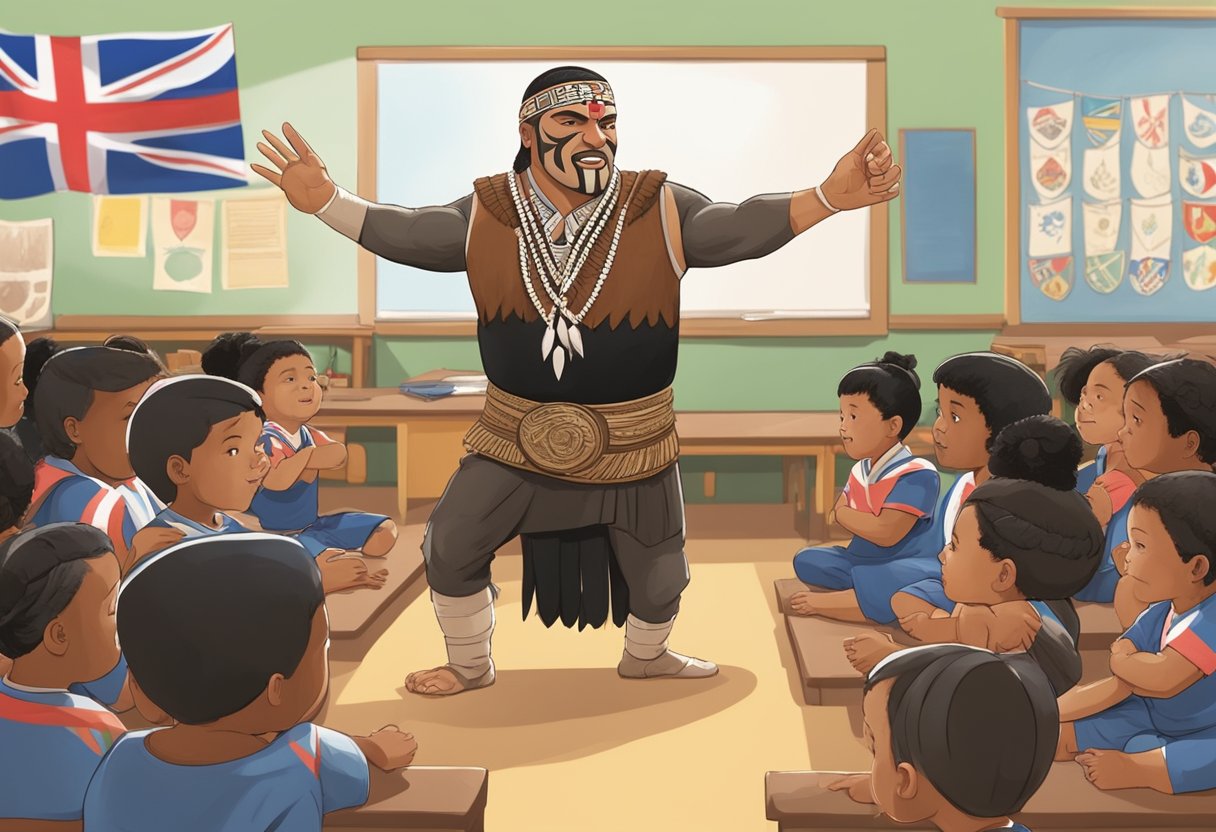
Comprehension: The Creation of New Zealand
No source passage was supplied for this heading, so this lesson uses an original Class-Mate supplemental passage based on Māori traditions about Māui and Te Ika-a-Māui.
Traditional narratives can preserve identity, names, values and relationships with place.
📘 Rules & How It Works
| Rule / Concept | Detailed Explanation |
|---|---|
| Rule | Sequence the events before answering. |
| Rule | Use text evidence for cause and effect. |
| Rule | Treat Māori names and traditions respectfully. |
| Rule | Do not present the traditional narrative as a modern geological explanation. |
✏️ Worked Examples
| Example | Explanation / Correct Use |
|---|---|
| Māui hides in the waka | joins the fishing trip → casts a special hook → hauls up a great fish. |
| Example | The North Island is known in the tradition as Te Ika-a-Māui . |
| Example | In some traditions the South Island is Te Waka-a-Māui . |
⚠️ Common Mistakes
| Incorrect / Problem | Correct Form / Explanation |
|---|---|
| Common mistake | Do not describe a living cultural tradition as 'just a made-up story'. |
| Common mistake | Do not claim the passage is a scientific account of plate tectonics. |
| Common mistake | Different traditions may contain different details. |
🌊 ORIGINAL CLASS-MATE SUPPLEMENTAL COMPREHENSION
According to a well-known Māori tradition, Māui wanted to prove himself to his older brothers. When they prepared to go fishing, they refused to take him, so Māui hid in their waka, or canoe, and only appeared after they were far from land.
Māui persuaded his brothers to paddle into deep water. He carried a special fishhook which, in many versions of the tradition, was made from the jawbone of his grandmother. He cast the hook into the sea and soon felt a tremendous pull.
With great effort, Māui hauled a gigantic fish from the ocean. In Māori tradition this great fish became the North Island of Aotearoa New Zealand, known as Te Ika-a-Māui — the Fish of Māui. In some traditions, the South Island is Māui’s canoe, Te Waka-a-Māui.
Māui warned his brothers not to cut the great fish while he was away. They did not obey him. They began cutting the fish and, in the traditional story, the cuts became the mountains, valleys, plains and cliffs of the land.
This is a traditional cultural narrative, not a scientific explanation of how islands formed. Stories such as this carry names, identity, values and connections between people and place across generations.
🧩 Guided Practice
1. Why does Māui hide in the canoe?
2. What becomes the North Island in the tradition?
3. What do the brothers' cuts explain in the story?
🎯 Independent Challenge
Create a six-event sequence strip then explain in 80 words why the story is culturally important even though it is not a geology lesson.
Power Quiz
Apply what you learned. Score 80% or more to master this lesson.
1. Why does Māui hide in the waka?
2. What does the great fish become in the tradition?
3. What does Te Ika-a-Māui mean in this lesson?
4. What do the brothers' cuts become in the traditional narrative?
5. How should this passage be understood?
Simple sentences

Simple sentences
A simple sentence contains one main independent clause and expresses a complete thought.
It can be short or long. Sentence type depends on clause structure, not number of words.
📘 Rules & How It Works
| Rule / Concept | Detailed Explanation |
|---|---|
| Rule | A complete simple sentence needs a subject and finite verb. |
| It may have a compound subject | Musa and Sam laughed. |
| It may have a compound verb | Musa laughed and waved. |
| Rule | It still has one main clause. |
✏️ Worked Examples
| Example | Explanation / Correct Use |
|---|---|
| Short | Birds sing. |
| Longer simple sentence | The small yellow bird sings beautifully in the garden every morning. |
| Compound subject | Mia and Sam laughed. |
⚠️ Common Mistakes
| Incorrect / Problem | Correct Form / Explanation |
|---|---|
| Common mistake | Fragment: ❌ Because the rain fell. This leaves the thought unfinished. |
| Common mistake | Run-on sentences are not made correct by simply adding more words. |
| Common mistake | Do not decide 'simple' by counting words. |
🧩 Guided Practice
1. Is 'The old dog slept beside the fire' simple?
2. Is 'Because the bus was late' complete?
3. Write a long simple sentence with one main clause.
🎯 Independent Challenge
Sort 12 examples into simple sentences and fragments then repair every fragment.
Power Quiz
Apply what you learned. Score 80% or more to master this lesson.
1. Which is a complete simple sentence?
2. Can a simple sentence be long?
3. Which group of words is a sentence fragment rather than a complete simple sentence?
4. Is 'Sam and Neo laughed' a simple sentence?
5. What makes a sentence simple?
Conjunctions

Conjunctions
A conjunction joins words, phrases or clauses. The conjunction chosen should show the relationship between ideas.
Coordinating conjunctions include and, but, or, so, yet. Subordinating conjunctions include because, when, if, although, while.
📘 Rules & How It Works
| Rule / Concept | Detailed Explanation |
|---|---|
| and | addition. |
| but/yet | contrast. |
| or | choice. |
| so | result. |
| because | reason. |
| although | unexpected contrast. |
✏️ Worked Examples
| Example | Explanation / Correct Use |
|---|---|
| Example | It rained, so the match was cancelled. |
| Example | The match was cancelled because it rained. |
| Example | I was tired, but I finished the race. |
⚠️ Common Mistakes
| Incorrect / Problem | Correct Form / Explanation |
|---|---|
| Common mistake | ❌ Because it rained. This may be a fragment if nothing follows. |
| Common mistake | Do not join ideas with a conjunction that changes the logic. |
| Common mistake | A comma is often used before a coordinating conjunction joining two complete clauses. |
🧩 Guided Practice
1. Choose: I stayed home ___ I was sick.
2. Choose: It was late, ___ we continued working.
3. Join: It rained. We stayed inside.
🎯 Independent Challenge
Join ten pairs of sentences using five different conjunctions and label the relationship each one shows.
Power Quiz
Apply what you learned. Score 80% or more to master this lesson.
1. Which conjunction shows contrast?
2. Complete: 'It was raining, ___ we stayed inside.'
3. Which conjunction most clearly gives a reason?
4. Which sentence uses the conjunction logically?
5. What does 'or' commonly show?
Figures of speech

Figures of speech
Figures of speech use language imaginatively to create comparison, sound, emphasis or imagery.
Grade 5 learners should recognise simile, metaphor, personification, hyperbole and sound devices such as alliteration and onomatopoeia.
📘 Rules & How It Works
| Rule / Concept | Detailed Explanation |
|---|---|
| Rule | Simile uses like/as. |
| Rule | Metaphor compares directly. |
| Rule | Personification gives human qualities to non-human things. |
| Rule | Hyperbole deliberately exaggerates. |
| Rule | Sound devices create effects through repeated or imitated sounds. |
✏️ Worked Examples
| Example | Explanation / Correct Use |
|---|---|
| Simile | The moon shone like a silver coin. |
| Metaphor | The classroom was a zoo. |
| Personification | The wind whispered. |
| Hyperbole | I waited forever. |
⚠️ Common Mistakes
| Incorrect / Problem | Correct Form / Explanation |
|---|---|
| Common mistake | Do not interpret figures of speech literally. |
| Common mistake | Do not name the device only; explain the image or effect. |
| Common mistake | 'I like pizza' is not a simile because no comparison is made. |
🧩 Guided Practice
1. Identify: The leaves danced.
2. Identify: She is as brave as a lion.
3. Explain: The classroom was a zoo.
🎯 Independent Challenge
Collect six figures of speech from books, adverts or your own writing and explain the effect of each.
Power Quiz
Apply what you learned. Score 80% or more to master this lesson.
1. Which is a simile?
2. Which is personification?
3. Which is hyperbole?
4. Which is a metaphor?
5. What should you do after identifying a figure of speech?
Alliteration

Alliteration
Alliteration is the repetition of the same or similar beginning consonant sound in nearby words.
It is about sound, not simply matching first letters.
📘 Rules & How It Works
| Rule / Concept | Detailed Explanation |
|---|---|
| Repeated initial sound | wild winds whistle . |
| Rule | Writers use it for rhythm, emphasis, humour and memorability. |
| Rule | It is common in poetry, slogans, titles and tongue twisters. |
✏️ Worked Examples
| Example | Explanation / Correct Use |
|---|---|
| Example | Busy bees buzz beside bluebells. repeats the /b/ sound. |
| Example | Peter packed purple pencils. repeats /p/. |
⚠️ Common Mistakes
| Incorrect / Problem | Correct Form / Explanation |
|---|---|
| Common mistake | Do not confuse alliteration with rhyme. Rhyme usually repeats ending sounds. |
| Common mistake | Too much alliteration can sound forced. |
| Common mistake | Words with the same first letter do not always begin with the same sound. |
🧩 Guided Practice
1. Find repeated sound: wild winds whistle.
2. Is cat/cold alliteration?
3. Write a four-word /s/ alliterative phrase.
🎯 Independent Challenge
Create a Class-Mate slogan and a four-line tongue twister using alliteration without making the wording meaningless.
Power Quiz
Apply what you learned. Score 80% or more to master this lesson.
1. Which phrase uses alliteration?
2. Which sound feature defines alliteration?
3. How is alliteration different from rhyme?
4. Which sentence best shows alliteration?
5. Why might a writer use alliteration?
Onomatopoeia

Onomatopoeia
Onomatopoeia is a word that imitates or strongly suggests a sound.
It helps readers hear an action in their imagination.
📘 Rules & How It Works
| Rule / Concept | Detailed Explanation |
|---|---|
| Rule | buzz, hiss, crash, bang, splash, tick-tock, sizzle. |
| Rule | Sound words are often used in comics, poems, action scenes and descriptions. |
| Rule | Different languages may represent the same sound differently. |
✏️ Worked Examples
| Example | Explanation / Correct Use |
|---|---|
| Example | Crack! The branch snapped. |
| Example | Bacon sizzled in the pan. |
| Example | Rain pitter-pattered on the roof. |
⚠️ Common Mistakes
| Incorrect / Problem | Correct Form / Explanation |
|---|---|
| Common mistake | Onomatopoeia does not mean every noisy word. |
| Common mistake | Alliteration repeats starting sounds. Onomatopoeia represents a sound itself. |
🧩 Guided Practice
1. Sound of a bee.
2. Sound of food frying.
3. Write a sentence using 'crash'.
🎯 Independent Challenge
Describe a thunderstorm using at least six different onomatopoeic words.
Power Quiz
Apply what you learned. Score 80% or more to master this lesson.
1. Which word is onomatopoeia?
2. Which sentence contains onomatopoeia?
3. Which sound word best suits a bee?
4. What does onomatopoeia help a reader imagine?
5. How is it different from alliteration?
Simile

Simile
A simile compares two different things using like or as.
The purpose is to transfer a useful quality from one thing to another.
📘 Rules & How It Works
| Rule / Concept | Detailed Explanation |
|---|---|
| Pattern 1 | X is like Y. |
| Pattern 2 | X is as adjective as Y. |
| Rule | A genuine comparison must be present. |
✏️ Worked Examples
| Example | Explanation / Correct Use |
|---|---|
| The moon was like a silver coin. shared quality | round/bright. |
| She ran as fast as lightning. shared quality | speed. |
| His hands were as cold as ice. shared quality | coldness. |
⚠️ Common Mistakes
| Incorrect / Problem | Correct Form / Explanation |
|---|---|
| Common mistake | I like apples. is not a simile because like is a verb meaning enjoy. |
| Common mistake | Avoid comparisons that do not make sense: ❌ The pencil was as hungry as a chair. |
🧩 Guided Practice
1. Identify comparison: The clouds were like cotton.
2. What quality is shared?
3. Create a simile for a very noisy place.
🎯 Independent Challenge
Write five original similes and explain the shared quality in each.
Power Quiz
Apply what you learned. Score 80% or more to master this lesson.
1. Which sentence contains a simile?
2. What is compared in 'The water was as smooth as glass'?
3. Which is NOT a simile?
4. Why do writers use similes?
5. Which completion forms a sensible simile: 'The baby’s skin was as soft as ___'?
Metaphor

Metaphor
A metaphor compares two unlike things directly without using like or as.
The writer does not mean the comparison literally. The reader transfers qualities from one image to another.
📘 Rules & How It Works
| Rule / Concept | Detailed Explanation |
|---|---|
| X is Y | The classroom was a zoo. |
| Rule | Metaphors can appear in many grammatical forms. |
| Rule | Explain both the comparison and what it suggests. |
✏️ Worked Examples
| Example | Explanation / Correct Use |
|---|---|
| Example | Time is a thief. suggests time takes moments away. |
| Example | The road was a ribbon. suggests long, narrow or winding shape. |
| Example | My brother is a night owl. suggests he stays awake late. |
⚠️ Common Mistakes
| Incorrect / Problem | Correct Form / Explanation |
|---|---|
| Common mistake | Do not say the classroom literally contains zoo animals. |
| Common mistake | Do not confuse like -based comparisons with metaphors. |
| Common mistake | An explanation such as 'it is a metaphor because it is a metaphor' is not enough. |
🧩 Guided Practice
1. Explain 'The test was a mountain'.
2. Change simile to metaphor: Her eyes were like stars.
3. Identify compared ideas: Time is a thief.
🎯 Independent Challenge
Create five metaphors and write a literal explanation underneath each one.
Power Quiz
Apply what you learned. Score 80% or more to master this lesson.
1. Which sentence is a metaphor?
2. Does a metaphor usually use like/as to make the comparison?
3. What does 'He is a walking dictionary' most likely suggest?
4. Which sentence is literal?
5. What should a reader explain about a metaphor?
Personification

Personification
Personification gives human actions, feelings or qualities to something non-human.
It can make weather, objects or nature seem alive and can create mood.
📘 Rules & How It Works
| Rule / Concept | Detailed Explanation |
|---|---|
| Rule | Look for a non-human subject. |
| Rule | Check whether the action/feeling is human-like. |
| Rule | Explain what image or mood the personification creates. |
✏️ Worked Examples
| Example | Explanation / Correct Use |
|---|---|
| Example | The wind whispered through the trees. |
| Example | The sun smiled down on us. |
| Example | The angry storm attacked the coast. |
⚠️ Common Mistakes
| Incorrect / Problem | Correct Form / Explanation |
|---|---|
| Common mistake | A real animal action is not automatically personification: The dog barked is literal. |
| Common mistake | Do not identify any descriptive verb as personification unless it gives a human-like quality. |
🧩 Guided Practice
1. Identify what is personified: The moon watched us.
2. Explain 'The leaves danced'.
3. Personify a school bell.
🎯 Independent Challenge
Write six personification sentences: two about weather, two about objects and two about nature.
Power Quiz
Apply what you learned. Score 80% or more to master this lesson.
1. Which sentence uses personification?
2. What is personified in 'The alarm clock screamed at me'?
3. Why might a poet use personification?
4. Which is NOT personification?
5. What human quality is given in 'The sun smiled'?
Rhyme

Rhyme
Rhyme occurs when words have the same or similar ending sounds, especially at the ends of poetic lines.
Rhyme is based on sound, not spelling.
📘 Rules & How It Works
| Rule / Concept | Detailed Explanation |
|---|---|
| Rule | light/night; play/day; blue/you. |
| Rule | End rhyme appears at line endings. |
| Rhyme scheme labels patterns using letters | AABB, ABAB and so on. |
| Rule | Not every poem rhymes. |
✏️ Worked Examples
| Example | Explanation / Correct Use |
|---|---|
| Line 1 | I saw the moon so bright (A) |
| Line 2 | It filled the silent night (A) |
| Line 3 | The wind began to play (B) |
| Line 4 | Before the break of day (B) |
⚠️ Common Mistakes
| Incorrect / Problem | Correct Form / Explanation |
|---|---|
| Common mistake | Words that look similar may not rhyme. |
| Common mistake | Do not force awkward word choices just to create rhyme. |
| Common mistake | Rhyme and rhythm are related but different. |
🧩 Guided Practice
1. Do light/night rhyme?
2. Label scheme: cat/hat, sun/run.
3. Find a rhyme for 'blue'.
🎯 Independent Challenge
Write four lines with an ABAB rhyme scheme and label the scheme.
Power Quiz
Apply what you learned. Score 80% or more to master this lesson.
1. Which pair rhymes?
2. What does a poem’s rhyme scheme describe?
3. Rhyme depends mainly on what?
4. Must every poem rhyme?
5. What rhyme scheme is formed by endings moon/night/light/bright if moon does not rhyme with the others but night/light/bright do?
Rhythm

Rhythm
Rhythm is the beat and flow of language. It comes from patterns of stressed and unstressed syllables, pauses, repetition and line length.
You often notice rhythm more easily when a poem is read aloud.
📘 Rules & How It Works
| Rule / Concept | Detailed Explanation |
|---|---|
| Rule | Syllables create units of sound. |
| Rule | Stress gives certain syllables or words extra emphasis. |
| Rule | Punctuation creates pauses. |
| Rule | Repetition can reinforce beat. |
| Rule | Rhythm may speed up or slow down a poem. |
✏️ Worked Examples
| Example | Explanation / Correct Use |
|---|---|
| Clap while saying | PIT-ter PAT-ter RAIN-drops FALL . |
| Example | Short repeated words can create a quick rhythm. |
| Example | Longer lines and pauses may create a slower pace. |
⚠️ Common Mistakes
| Incorrect / Problem | Correct Form / Explanation |
|---|---|
| Common mistake | Rhythm is not the same as rhyme. |
| Common mistake | Do not read every line at exactly the same speed. Punctuation and meaning affect pace. |
| Common mistake | Counting syllables alone does not fully explain rhythm. |
🧩 Guided Practice
1. Clap the syllables in 'pitter-patter'.
2. Where might a comma affect rhythm?
3. Explain difference between rhythm and rhyme.
🎯 Independent Challenge
Choose a four-line poem, mark natural stresses and pauses and perform it twice with different pace. Discuss the effect.
Power Quiz
Apply what you learned. Score 80% or more to master this lesson.
1. What is rhythm in poetry?
2. What can help you notice rhythm?
3. Which can influence rhythm?
4. Which statement correctly contrasts rhythm with rhyme?
5. What effect can a pause have?
Poem

Poem
A poem uses carefully chosen words, lines, stanzas, images and sounds to express experiences, feelings or ideas.
Read a poem more than once. First understand what is happening. Then analyse how the poet’s language creates the effect.
📘 Rules & How It Works
| Rule / Concept | Detailed Explanation |
|---|---|
| Rule | Identify the speaker, subject and mood. |
| Rule | Look for line and stanza structure. |
| Find sound devices | rhyme, rhythm, alliteration, onomatopoeia. |
| Find figurative language | simile, metaphor, personification. |
| Rule | Explain effect, not just device name. |
✏️ Worked Examples
| Example | Explanation / Correct Use |
|---|---|
| Example | In Rain Song , pitter-patter suggests sound through onomatopoeia. |
| Example | Wind whispers is personification. |
| Example | Branches bow also gives a human-like action. |
| Example | play/day and run/sun form rhyming pairs. |
⚠️ Common Mistakes
| Incorrect / Problem | Correct Form / Explanation |
|---|---|
| Common mistake | Do not assume the speaker is always the poet. |
| Common mistake | Do not call every repeated sound rhyme. |
| Common mistake | Do not identify a technique without explaining what it adds. |
📝 ORIGINAL CLASS-MATE PRACTICE POEM — RAIN SONG
Rain Song
Pitter-patter, raindrops play,
Drumming softly through the day.
Silver rivers race and run,
Clouds hide away the golden sun.
Wind whispers, “Come and dance with me,”
Branches bow beside the tree.
Then the storm begins to slow,
And puddles catch the rainbow’s glow.
🧩 Guided Practice
1. Find one onomatopoeic phrase.
2. Find one personification.
3. Name one rhyming pair.
🎯 Independent Challenge
Annotate Rain Song by marking rhyme, rhythm clues, onomatopoeia, personification, mood and one favourite image.
Power Quiz
Apply what you learned. Score 80% or more to master this lesson.